Buckwheat was once a popular food staple in Germany before it nearly vanished from memory. Now it’s making a comeback – on dining tables and hopefully soon in our fields. But this resilient plant has even more potential.
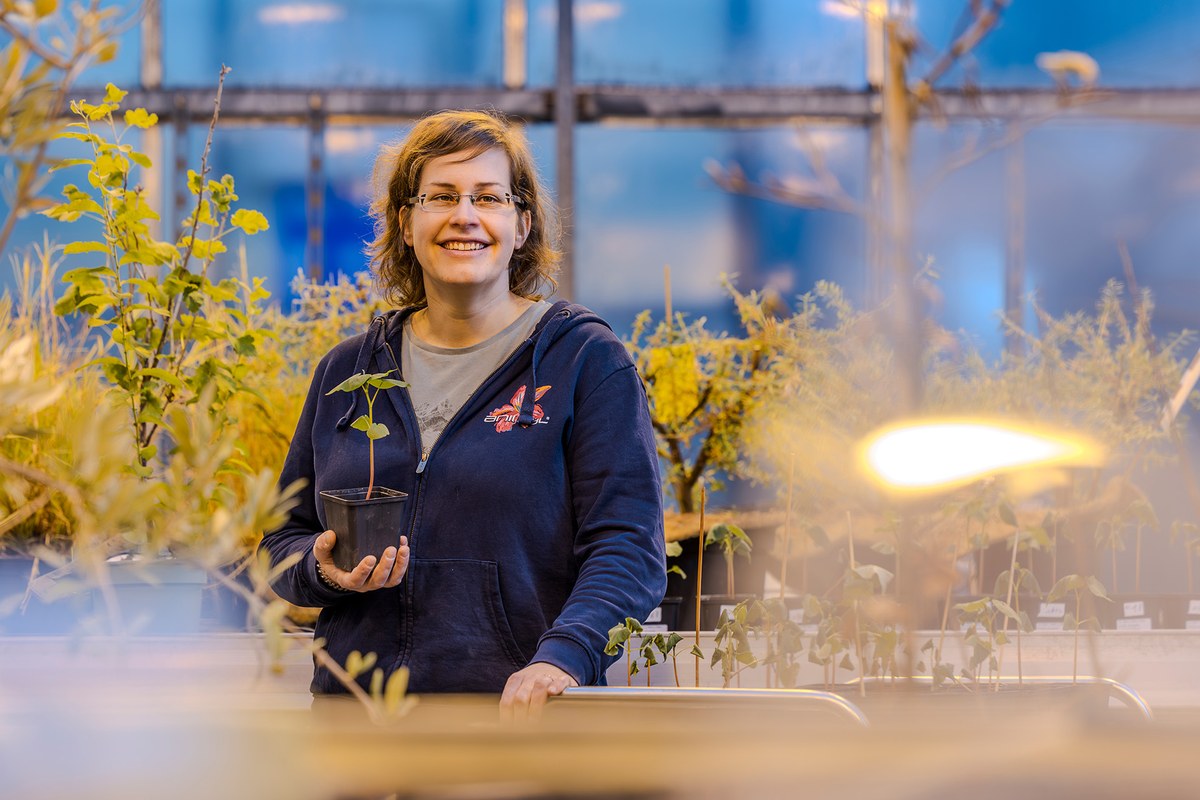
A piece of the future lies in her hands: Laura Junker-Frohn with buckwheat in the IBG-2 greenhouse.Copyright: Forschungszentrum Jülich/Sascha Kreklau
Whether in pancakes, porridge, or dumplings, buckwheat was an everyday food for many generations. Originally from Asia, the plant was cultivated throughout Central Europe from the 16th to the mid-20th century. But unlike in Eastern Europe, Russia, and China, the crop disappeared from German fields and kitchens. Higher-yielding cereals pushed it aside – a development that plant researcher Dr. Laura Junker-Frohn from the Institute of Bio- and Geosciences (IBG-2) considers unjustified. “Buckwheat has many interesting properties. Its fast growth, low fertilizer requirements, and reliance on insect pollination are particularly valuable for climate-resilient agriculture,” the scientist emphasizes.
Interest in the plant is also growing among the general public: buckwheat is gluten-free and is therefore increasingly appearing in modern recipes and products. For industry, its unique composition of plant compounds could be a source of bio-based compounds to establish bioeconomic value chains. Today, the plant can once again be found in German fields, albeit on a minimal scale compared with export powerhouses such as Russia and China, where hundreds of thousands of hectares are under cultivation.
New varieties, new opportunities
Junker-Frohn is working to support the plant’s comeback through scientific research. In the BIMOTEC project that she coordinates, she works alongside colleagues from IBG-2 and the Bioinformatics (IBG-4) institute division, as well as partners from plant breeding and industry, to lay the foundations for re-establishing buckwheat as a multi-purpose crop in Germany. This requires breeding of new, climate-resilient varieties. As Junker-Frohn explains: “Breeding of buckwheat as a food crop was discontinued in Germany over 50 years ago. Cultivars that farmers grow today come from other countries and are not adapted to local conditions. There is a lot of potential for plant breeding.”
Buckwheat has many properties that are valuable, particularly in times of climate change
To explore this, the scientists use rhizotrons – special growth containers with a transparent side that permit a view of the roots and are arranged in long rows in the greenhouse on the Jülich campus. The containers are part of the GrowScreen-Rhizo 3 phenotyping platform developed at the institute, which allows root and shoot growth to be monitored automatically. Cameras capture the growth of several hundred plants each day, enabling comparisons of around 50 different buckwheat varieties. These images then feed into the analysis: How does the root system develop under drought conditions? Which varieties can cope with low nitrogen fertilization?
“Using the data, we can identify which varieties are particularly stress-tolerant,” says Junker-Frohn. In parallel, project partners at the University of Hohenheim are working on a mathematical model to simulate plant growth under different conditions and predict yields. This also helps to further optimize cultivation. The ultimate goal is to develop new buckwheat varieties that deliver stable yields in German fields while also being able to cope with climatic stress factors.
But the team isn’t solely focused on grain yield. “We’re looking at how the entire plant can be used,” explains the researcher. For example, the Fraunhofer Institute for Molecular Biology and Applied Ecology is searching for valuable substances in leaves and seed hulls for the pharmaceutical and food industries. Its industry partner Phytowelt GreenTechnologies is testing how the compound rutin can be extracted on a large scale and optimized as a pharmaceutical ingredient. In addition, the stem could serve as a bio-based raw material, offering an alternative to fossil raw materials.
A Comeback for Buckwheat – Interview with Laura Junker-Froh
BIMOTEC research project wants to bring forward the comeback of buckwheat to meet the growing demand by revealing its bioeconomic potential. In an interview with Laura Junker-Frohn we learn how the project aims to revive buckwheat and why this crop deserves to become firmly established in agriculture again.
By growing buckwheat, farmers are also doing their fields a favour. Today, buckwheat is already used as cover crop to loosen the soil and keep it healthy. However, so far, buckwheat sown after the main harvest is just a cover crop that is not harvested. With the increasing length of the growing season, buckwheat could be planted as a second crop, as it is undemanding and grows well even later in the year. When planted after the harvest of winter cereals or early potatoes, fields would not lie fallow. Although buckwheat grain yield is undoubtedly lower compared to established cereals, it would thereby generate additional financial returns for the farmer.
Three facts about buckwheat
A nutrient powerhouse
Buckwheat contains all eight essential amino acids, B vitamins, minerals, and antioxidants such as rutin and quercetin. It also contains essential fatty acids such as linoleic acid. However, only the hulled grains are used for food; they are processed into flour, flakes, groats, or kernels. Kernels and flakes are suitable for muesli or for garnishing salads.
A gluten-free grain alternative
Buckwheat is a pseudocereal. This term is used to describe dicotyledonous plant species, whose seeds are used in similar ways to grains of cereal crops – for example, as flour in baking. Buckwheat is naturally gluten-free and therefore suitable for people who are gluten intolerant or suffer from coeliac disease.
Resilient
Buckwheat ripens quickly (3–4 months) and can reach heights of up to 100 cm. It requires little fertilizer and thrives even in sandy or acidic soils – including reclaimed open-cast mining areas However, it does not tolerate the cold, and frost damage can occur at just above freezing.
Laura Junker-Frohn and her colleagues are working to transform buckwheat into a multi-purpose crop that generates not only grains, but also valuable biomass, and can be easily integrated into farmers’ crop rotation procedures. Buckwheat also contributes to agrobiodiversity – the diversity of cultivated plants – because it is not related to any other common crop. And bees benefit from its nectar later in the year, when hardly anything else is in bloom.
“Considering all these factors, we see a lot of potential for buckwheat to make a comeback,” concludes Junker-Frohn. “But it will take some time and diligence.”
This text is taken from the 2/25 issue of effzett. Text: Anna Tipping