

Go to Online-effzett for the latest topics and background information
Open to new ideas
Anke Nölscher wants to understand how the atmosphere works – and how everything is interconnected. Her approach: learning new things, recognizing connections, and finding solutions together.
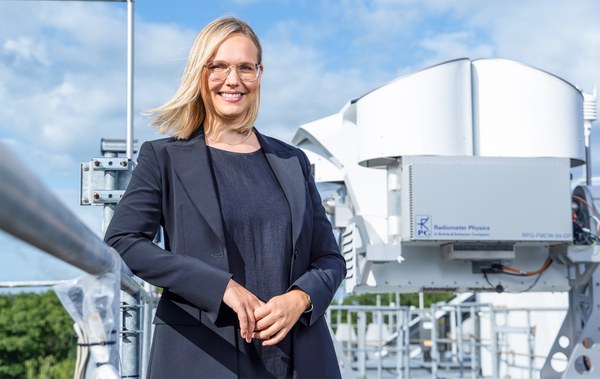
When Anke Nölscher talks about her work, she rarely talks about herself – it’s mostly about her team, shared ideas, and exchanges with others. “At Jülich, I’m currently having many discussions with colleagues, including those from other institutes. This is extremely exciting because it gives you new perspectives – and often leads to unexpected new approaches,” she says. For her, scientific work is collaborative work.
Since April 2025, the meteorologist has been the head of the Troposphere (ICE-3) institute division at the Institute of Climate and Energy Systems. Additionally, she teaches Earth system sciences and atmospheric chemistry at the University of Cologne. She designs her courses to be interdisciplinary. “The enthusiasm comes from the exchange,” she emphasizes. For example, her inaugural lecture is part of the lecture series “Modern Earth System Sciences,” which brings together students from natural, social, and medical sciences – perfectly reflecting her approach of interdisciplinary thinking and working together.
Conveying knowledge is a central task of climate research.
New ideas
Nölscher relies on interdisciplinary teams at ICE-3 that combine expertise in the areas of physics, chemistry, biology, data science, and engineering. These teams work on projects ranging from global models to complex laboratory experiments. For Nölscher, it is important to understand and bring together the many facets of the atmosphere: the physical dynamics of wind and weather, the chemical reactions of trace gases, the natural emissions of plants, and human-made pollutants. “Everything is connected – and only by looking at all the pieces of the puzzle can we understand how the Earth system works,” stresses the meteorologist.
Her goal is to combine traditional research topics with new ideas. ICE-3 focuses on the interactions between the Earth and the lower atmosphere in the context of climate change and their influence on air quality. From Nölscher’s perspective, one new area of interest is the atmospheric transport of microplastics. “So far, microplastics have mainly been studied in the oceans and in soil. Very little is known about their atmospheric distribution,” says Nölscher.
Nölscher has always been fascinated by the unknown: “Every stage of my studies and my career has been an opportunity to learn something new – always with the aim of better understanding the processes in the atmosphere and, in turn, the Earth system.” After studying meteorology, she completed her doctorate in 2012 at the Max Planck Institute for Chemistry in Mainz, where she studied the physical and chemical interactions between the atmosphere and forests. Back then, she worked for the first time at the Jülich atmospheric simulation chamber SAPHIR – a facility that still fascinates her today. This 270 m³ chamber can be used to simulate and precisely analyse a wide variety of air mixtures – from clean forest air to polluted city air.
Her curiosity drove her even further out into the world. During her doctoral studies, she conducted research in forests from Finland to Brazil. There she learned how to plan measurement campaigns under challenging conditions – and to improvise when necessary. “If a measuring instrument doesn’t work, there’s always a logical reason that can be found and solved technically. There is a solution for every problem,” she explains.
The importance of teamwork was highlighted during an international measurement campaign on the Canary Islands: “We wanted to investigate the impact of climate change on the exchange between the ocean and the atmosphere. However, the entire experimental setup was destroyed by a storm. That was tough. We had to improvise and quickly set up smaller experiments – such an effort can only succeed through teamwork.”
If not now, then when?
During her postdoctoral stay at the California Institute of Technology in Pasadena, USA, she investigated how natural emissions from plants react with human-made pollutants and learned about other measurement methods and new sensor technology. When she returned to Germany, the expertise she gained in the US served as a good foundation.
At the German Weather Service, she took over responsibility coordinating projects around the measurement network with over 1,000 stations. “The numerous sensors installed there have to be managed. Many people ensure that the measuring instruments work smoothly around the clock and continuously deliver data. Teamwork and good organization were essential here,” she says. The job also suited her family situation with two small children. However, she still had a desire to work scientifically and to teach. When a junior professorship was advertised in Bayreuth in 2018 – one that matched her profile exactly – the decision was easy: “If not now, then when?”
In her new research environment, Nölscher devoted herself to the question of how ultrafine particles are distributed in the atmosphere and how they could impact air quality. The particles are no more than 100 nm in size and can pose a health risk. They also influence cloud formation and incoming solar radiation. She compared samples from regions with varying levels of pollution – from Munich Airport to the Zugspitze mountain. The aim was to obtain chemical fingerprints and insights into the origin, distribution, and impact of ultrafine particles.
Her extensive knowledge fits in very well with the atmospheric research expertise that Jülich has developed over decades. As the new director of the Troposphere institute division, she aims to continue its successful path – while contributing fresh ideas and perspectives. Communication plays an important role here. “Conveying knowledge – for example, to the public and policymakers – is a central task of climate research. It is important that we engage in intensive dialogue about global challenges such as the climate crisis, for example at the UN Climate Change Conference, in order to find a common path moving forward,” says Nölscher. Finally, she draws attention to the recent appeal made by the German Meteorological Society and the German Physical Society: “Given the accelerating pace of global warming, more decisive action is needed.”
This text is taken from the 2/25 issue of effzett. Text: Brigitte Stahl-Busse
Never miss an issue of effzett again


Last Modified: 10.12.2025